
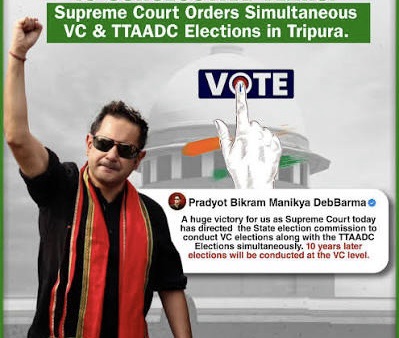
The Supreme Court has sharply questioned the Tripura Government and the State Election Commission (SEC) over the decade‑long delay in conducting Village Committee (VC) elections under the Tripura Tribal Areas Autonomous District Council (TTAADC). The court expressed dissatisfaction with the explanations provided and demanded a clear, time‑bound schedule for restoring grassroots democracy in tribal regions.
H.H leader Pradyot Kishore Debbarma, who has long advocated for timely elections, described the court’s stance as a major victory for tribal communities. He emphasized that simultaneous VC and TTAADC elections—now mandated by the court—mark a turning point for local self‑governance and accountability.
What triggered the confrontation
A petition highlighting the government’s repeated delays and administrative excuses pushed the Court to intervene. The bench questioned why a state could allow grassroots democracy to collapse while an unelected ad‑hoc chairman controlled funds, decisions, and political influence across tribal villages.
Supreme Court’s stance
The Court demanded a concrete timeline for elections and signaled that prolonged inaction may amount to a violation of constitutional rights. Its tone suggested deep frustration with what appears to be systemic neglect rather than logistical difficulty.
Political and social impact
For tribal communities, the ruling is being hailed as a long‑overdue correction. Leaders advocating for electoral rights argue that the delay weakened local governance and enabled political manipulation. The Court’s intervention now forces the state to restore democratic accountability after nearly a decade of silence.